
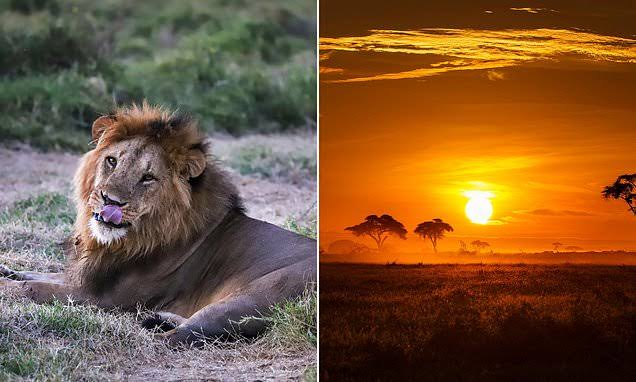
In a heartbreaking incident that has reignited concerns about human-wildlife conflict in Kenya, a 14-year-old girl lost her life after being attacked by a lion just outside Nairobi. The fatal encounter occurred at a residential compound situated on a ranch bordering the iconic Nairobi National Park.
According to the Kenya Wildlife Service (KWS), the lion managed to enter the premises under the cover of darkness, snatching the young girl from the compound. A fellow teenager who witnessed the attack raised the alarm, prompting a rapid response from KWS rangers. They followed the predator’s tracks to the banks of the Mbagathi River, where they discovered the remains of the young girl, who was still in primary school.
The lion responsible for the attack has not yet been located, but KWS has confirmed that traps have been set and specialized search teams are combing the area in an effort to find the animal. In the meantime, enhanced security protocols have been introduced to safeguard communities living near wildlife zones.
“This is a deeply tragic and rare event,” a KWS spokesperson stated. “We are doing everything possible to locate the lion and prevent further loss of life.”
Also, read: Two Belgians Among Four Foreign Nationals Arrested in Kenya for Smuggling Over 5,000 Ants in Test Tubes
Nairobi National Park, situated just 10 kilometers from the heart of Kenya’s bustling capital, is home to a wide array of wildlife, including lions, leopards, giraffes, and buffalos. While it is fenced on three sides to prevent animals from straying into urban areas, its southern boundary remains open to allow for natural migration—an openness that can sometimes bring wild animals dangerously close to human settlements.
Although confrontations between lions and people in Kenya are not unheard of—especially when it comes to protecting livestock—fatal attacks on humans remain rare. Still, this tragedy is not an isolated incident. Just days earlier, a 54-year-old man died after being attacked by an elephant in Nyeri County, roughly 130 kilometers north of Nairobi. The elephant, grazing in Mere Forest, inflicted severe injuries including fractured ribs and internal trauma. Despite being rushed to a nearby hospital, the man succumbed to his wounds.
Wildlife conservationist Paula Kahumbu, CEO of WildlifeDirect, expressed sorrow over the recent events and urged the Kenya Wildlife Service to step up its efforts in monitoring and communicating wildlife movement. She called for better risk assessments and timely alerts for people living in high-risk zones, such as the Savannah Ranch, where the young girl was killed.
“These are not isolated events,” Kahumbu said. “We must treat every life—human and animal—with equal value, and prevention is our first and best line of defense.”
She also advocated for all lodges, camps, and residential properties near wildlife habitats to be outfitted with deterrent measures like secure fencing, floodlights, alarm systems, and predator-repelling sprays.
As the community mourns this devastating loss, the incident has brought renewed urgency to a difficult question: how can Kenya, a nation proud of its rich biodiversity, strike a better balance between human safety and wildlife conservation?

