
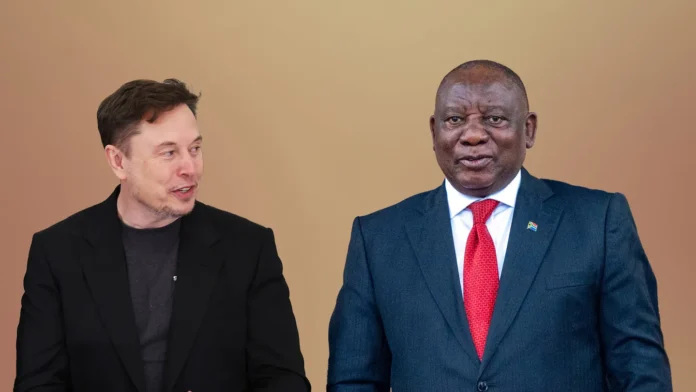
South African President Cyril Ramaphosa is headed to Washington this week with a bold strategy: leverage South Africa’s connection to Elon Musk to repair increasingly tense relations with U.S. President Donald Trump.
In what’s expected to be one of his most consequential diplomatic trips this year, Ramaphosa will meet with Trump on Wednesday to pitch a trade proposal that includes incentives for Musk’s companies—chief among them, Tesla and Starlink. The goal? Resetting a strained bilateral relationship that’s taken hits during Trump’s second term in office.
Sources within the South African government say one offer on the table could see Tesla benefit from reduced tariffs on imports into South Africa. In exchange, Musk’s electric vehicle giant would invest in building out a national network of charging stations—an infrastructure South Africa sorely needs as it eyes a cleaner energy future amid its own power supply struggles.
The move is strategic and, some might say, ironic.
Musk, a native of Pretoria, has had a rocky relationship with South African leadership. He has previously slammed the country’s economic policies, accusing them of being racially exclusionary. Last year, he took aim at the government’s Black Economic Empowerment (BEE) regulations, claiming that Starlink—his satellite internet venture—was banned from South Africa because he is “not Black.”
Also, read: Equatorial Guinea Wins Decades-Long Battle Over Oil-Rich Islands Near Gabon
South African officials swiftly pushed back, clarifying that Starlink failed to meet the BEE requirement of 30% local Black ownership for telecommunications licenses. While Starlink now operates in 17 African countries, including South Africa’s neighbors Namibia, Botswana, and Mozambique, the continent’s most industrialized economy remains off the list.
That impasse reached a breaking point on August 14, 2023, when South Africa formally banned the import of Starlink kits, cutting off public access and stalling hopes of connectivity in rural areas.
But now, the tone appears to be shifting.
Ramaphosa’s Washington visit signals a pragmatic pivot. Facing domestic economic pressures and global diplomatic balancing acts, the South African leader is looking to reframe his country’s relationship with both Trump and Musk—not as adversarial, but as a potential win-win.
For Trump, welcoming a major investment proposal involving a high-profile ally like Musk could be politically appealing, especially amid his push to bolster American business interests abroad. For Musk, the deal could open a pathway back into South Africa’s market—on terms that satisfy both regulatory requirements and his own ambitions.
It remains to be seen whether this diplomatic gamble will pay off. But what’s certain is this: Ramaphosa’s charm offensive in Trump’s Washington is less about nostalgia and more about necessity. And at the center of it all is a billionaire who once called South Africa home.

