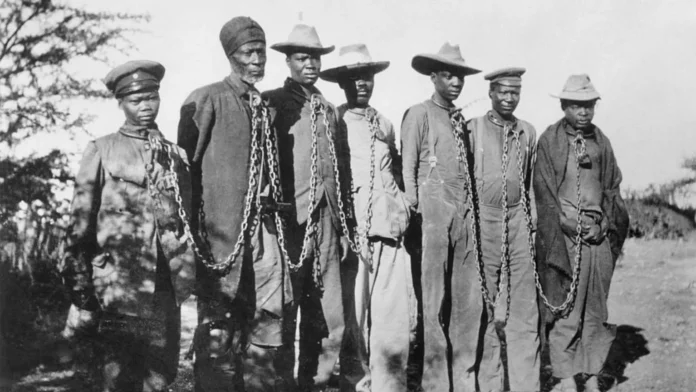
For the first time in its history, Namibia is officially observing a national Genocide Remembrance Day, honouring the tens of thousands of Ovaherero and Nama people who were systematically killed by German colonial forces in the early 20th century. The country marks this sombre occasion today, May 28, with vigils, a national minute of silence, and renewed calls for justice.
The new memorial day acknowledges one of the world’s most overlooked atrocities — often referred to as “Germany’s forgotten genocide.” Between 1904 and 1908, German forces brutally suppressed local resistance to colonial rule in what was then known as German South West Africa, now modern-day Namibia. The result was the near-extermination of entire communities, including the Ovaherero and Nama, through mass executions, forced displacement, and horrific conditions in concentration camps.
Though nearly 40 years before the Holocaust, these colonial crimes bore many of the same hallmarks: concentration camps, pseudoscientific experiments, and racially motivated extermination policies.
The Namibian government says this annual day of remembrance is part of a broader “journey of healing,” an effort to centre national reflection on a dark chapter long buried in global silence. The choice of May 28 is deeply symbolic—it marks the day in 1907 when Germany, under growing international criticism, announced the closure of its deadly camps.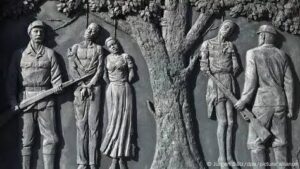
Outside Namibia’s parliament in Windhoek today, citizens gathered for a candlelight vigil and observed a minute of silence in honour of those lost. For many, this long-overdue recognition is deeply emotional.
“This day isn’t just about remembering the past; it’s about finally being seen,” said Maria Kaujeua, a descendant of genocide survivors. “Our pain, our stories, our history — it all matters.”
Still Waiting on Justice
Germany’s formal acknowledgement of the genocide came only four years ago. In 2021, Berlin offered €1.1 billion in development aid to Namibia, to be disbursed over 30 years — but carefully avoided calling the funds “reparations.” Namibia rejected the offer, calling it inadequate and devoid of the full apology and compensation that survivors’ descendants have long demanded.
Also, read: China Gifts 30,000-Seat Stadium to Chad
The backlash was swift.
“That was the joke of the century,” said Uahimisa Kaapehi, a town councillor in Swakopmund and an ethnic Ovaherero leader. “They took our land, our cattle, our dignity. You can’t heal a wound with hush money.”
Activists argue that the negotiations excluded the very communities most affected by the genocide. While a revised draft deal is reportedly in the works — with an additional €50 million and the prospect of a formal German apology — critics say that’s still not enough.
Some campaigners insist that true reparative justice would mean returning stolen ancestral lands, many of which remain in the hands of Namibia’s minority German-speaking population. Others argue for financial restitution that accounts for historical plunder — including 12,000 cows taken as so-called reparations by the German empire from local communities who dared to resist colonisation.
A Long Shadow
The genocide was triggered in 1904 when German military commander Lothar von Trotha issued an extermination order against the Ovaherero people. “No prisoners,” the order declared — a chilling prelude to what followed. Men, women, and children were executed or left to die in the desert. Survivors were herded into concentration camps, where they were starved, overworked, and subjected to scientific experiments intended to support white supremacist theories.
Namibian historian Martha Akawa-Shikufa described the horror plainly in an interview with the NBC:
“There were pre-printed death certificates that said ‘death by exhaustion.’ That tells you everything you need to know about how they expected our people to die.”
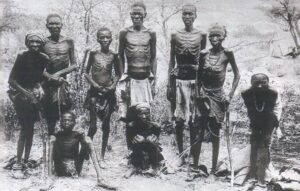 Even in death, the indignities continued. The skulls and bones of murdered Namibians were shipped to Germany for racist research. While some of those remains have been repatriated in recent years, calls for accountability remain louder than ever.
Namibia’s growing assertiveness around this historical injustice has rippled into global conversations. Last year, the Namibian government criticized Germany for offering to defend Israel against genocide allegations at the UN’s top court — a move seen by many as hypocritical given Germany’s unfinished reckoning in Namibia.
“The German government is yet to fully atone for the genocide it committed on Namibian soil,” the late President Hage Geingob said at the time.
As Namibia pauses today to honour its ancestors, many hope Genocide Remembrance Day becomes more than just a memorial. It’s a call — to truth, to justice, and to a world that too often forgets the suffering buried beneath the pages of empire.
“Recognition is not enough,” said activist Linda Garises. “Until there is real restitution, the healing remains incomplete.”

