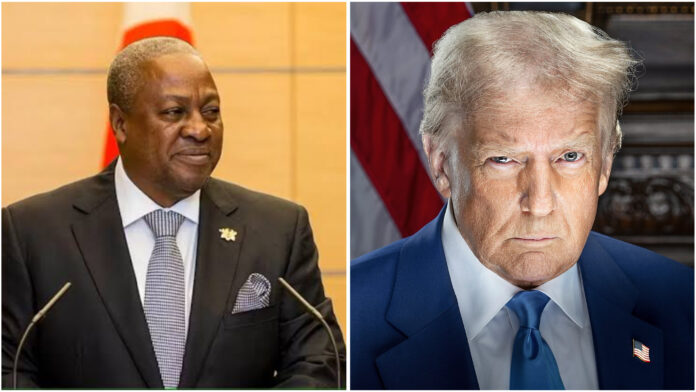
In a powerful rebuke of U.S. President Donald Trump, Ghanaian President John Dramani Mahama has condemned Trump’s recent remarks accusing South African President Cyril Ramaphosa of overseeing a so-called “white genocide” in his country. Mahama called the claims not only baseless, but a grave insult to the memory, dignity, and struggle of African people across the continent.
Speaking in the wake of Trump’s controversial statements during a White House meeting with Ramaphosa, Mahama asserted that the American president’s comments represent a dangerous distortion of historical truth and a deeply offensive misuse of language.
“This wasn’t just a false accusation,” Mahama said. “It was a denial of the lived trauma of Black South Africans, and by extension, an attack on the soul of Africa itself.”
Trump’s allegations of white genocide — a fringe theory popular in far-right circles — were quickly debunked by independent analysts. Yet during the meeting, he pressed the issue, even presenting misrepresented images, including one reportedly from the Democratic Republic of Congo.
President Mahama criticized Trump for not only misrepresenting facts but for exploiting history to serve a divisive narrative. “This is how the echoes of colonial oppression survive in modern times,” he said. “It’s not with armies now, but with carefully chosen words meant to fracture and discredit.”
Citing Kenyan writer Ngũgĩ wa Thiong’o, Mahama emphasized the enduring power of language as a tool of subjugation. “Language conquest, unlike the military form, is cheaper and more effective. That’s what we’re seeing again today.”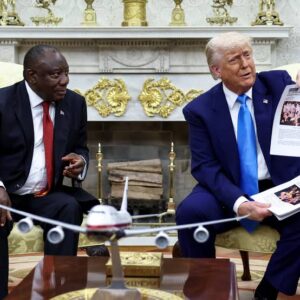
A Shared African Memory
Mahama drew on his own memories to highlight how closely Africa’s nations are tied together in their struggles for justice. He recalled being a teenager during the 1976 Soweto uprising in South Africa and being haunted by the photograph of Hector Pieterson’s body being carried after he was fatally shot by apartheid police.
Also, read: Tyla to Make History as First African to Host Nickelodeon Kids’ Choice Awards
“That image stayed with me,” Mahama said. “It made me realize that my freedom in Ghana was meaningless if children in South Africa were still dying for theirs.”
He stressed that South Africa’s transformation into a multiracial democracy was hard-won, and it never involved retribution against white citizens. “If Black South Africans truly sought revenge, they had every opportunity after 1994,” Mahama noted. “But they chose reconciliation. They chose nation-building.”
The Reality on the Ground
Despite post-apartheid progress, the legacy of inequality remains in South Africa, where white citizens still control a majority of the country’s wealth. Mahama pointed out the irony of Trump’s concern: “There are still towns like Orania and Kleinfontein where Black South Africans can’t live or work, where Afrikaner-only institutions exist — and yet, they call this genocide?”
Mahama also questioned why those who feel threatened don’t simply relocate to those self-segregated enclaves. “What more evidence do we need that this claim is a political ploy, not a humanitarian concern?”
In the face of such rhetoric, Mahama issued a plea for global leaders to act with integrity and historical awareness. “Our world is facing real crises — real genocides, real displacement, real suffering,” he said. “This is not the time for manufactured fear.”
He warned that careless language from powerful figures can reignite old divisions, especially when weaponized on the international stage.
Quoting Archbishop Desmond Tutu, Mahama said, “If you want to destroy a people, you destroy their memory.” He added: “But we remember. Africa remembers. Not just our pain, but our strength. Our unity. Our fight.”
Mahama’s remarks served as a sharp reminder that Africa’s history is not up for debate — nor will it be erased or rewritten by outside forces. As he put it, “We journey forward with truth as our compass. That truth is non-negotiable, and we will defend it — in memory, in legacy, and in the blood of those who came before us.”

