In what could be a major turning point for central Africa, Rwanda and the Democratic Republic of Congo (DR Congo)have reached a draft peace agreement aimed at ending years of violence in the eastern DR Congo region. The deal, mediated by the United States and Qatar, marks a cautious but hopeful step toward resolving one of the continent’s most stubborn and deadly conflicts.
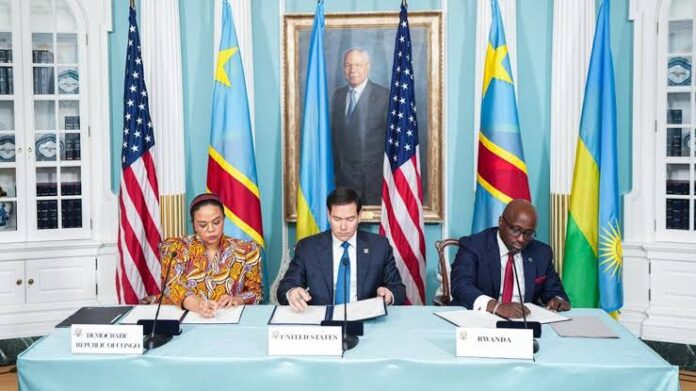
The agreement, initialled in Washington after three days of negotiations, includes key provisions for the “disengagement, disarmament, and conditional integration” of armed groups—most notably the M23 rebel group, which has seized control of large areas in eastern DR Congo over the past year.
According to a statement from the U.S. State Department, the draft was the result of “constructive dialogue regarding political, security, and economic interests” between both countries. A formal signing ceremony is expected next week, with U.S. Secretary of State Marco Rubio scheduled to attend.
The agreement also outlines the creation of a joint security mechanism—a critical move aimed at preventing future flare-ups along the volatile border.
Though it’s not the first time the two nations have come together to talk peace, this agreement builds on earlier negotiations held in April, where both parties committed to respecting each other’s sovereignty and drafting a detailed peace roadmap.
This breakthrough could pave the way for billions of dollars in Western investment into the mineral-rich region, which is home to vital resources like coltan, essential for global electronics manufacturing. With DR Congo recently turning to the U.S. for support—reportedly offering access to critical minerals—there’s added international pressure to ensure this peace holds.
But observers remain cautiously optimistic. Previous peace efforts, including deals mediated by Angola, have failed to gain full backing from both governments. Angola, once a key mediator, stepped away from the process in March after its efforts stalled.
Also, read: UK Bans South African Politician Julius Malema, Citing Public Safety Concerns and Extremist Rhetoric
One of the most pressing and controversial aspects of the deal is the future of the M23 rebel group, whose resurgence has reignited violence across the region. Despite widespread accusations, Rwanda denies backing the M23, claiming instead that its military presence in eastern DR Congo is a defensive measure against FDLR—a Hutu-led rebel group with ties to the 1994 Rwandan genocide.
DR Congo, for its part, denies supporting the FDLR but accuses Rwanda of covertly occupying Congolese territory.
The draft agreement touches on disarmament and withdrawal, but key questions remain unanswered:
• Will M23 fighters relinquish the territories they’ve captured?
• Will Rwanda admit to having troops on Congolese soil and agree to pull them out?
• Who will oversee the disarmament of the FDLR, especially after several failed attempts?
• Can displaced Congolese refugees currently in Rwanda return safely?
• Will Goma’s airport reopen to allow humanitarian aid into affected areas?
The renewed M23 offensive has forced hundreds of thousands of civilians from their homes, particularly after the capture of major cities like Goma and Bukavu earlier this year. Makeshift rebel governments have since been set up in some of these areas, and the humanitarian situation continues to deteriorate.
With thousands killed and the region still on edge, humanitarian agencies are calling for immediate access to vulnerable communities and for the reopening of critical infrastructure.
This draft peace agreement is not yet a resolution, but it is a long-awaited signal that both Rwanda and DR Congo recognize the cost of continued instability—not just in terms of regional security, but in lost human potential and global partnership.
For the people of eastern DR Congo—those who have lived under fear, displacement, and violence for far too long—hope now rests not in words, but in the actions that follow.

