
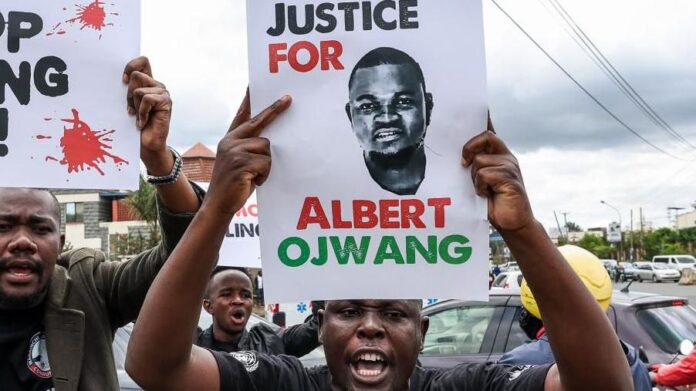
Tensions continue to rise across Kenya after three police officers and three civilians were formally charged with the murder of 31-year-old blogger Albert Ojwang, whose death in police custody earlier this month has sparked nationwide protests and renewed calls for police accountability.
Ojwang, a social media commentator known for his outspoken political posts, was arrested after Eliud Lagat, Kenya’s Deputy Police Chief, filed a complaint accusing him of defamation. Days later, Ojwang was dead. His passing, initially blamed on “self-inflicted injuries,” was later revealed by an autopsy to be the result of blunt-force trauma, consistent with an assault—forcing police to retract their original statement.
The case quickly ignited outrage online and in the streets, with citizens demanding justice and an end to what they describe as a pattern of state violence.
Six Charged, Lagat Steps Aside
On Monday, police officers Samson Kiprotich, Talaam James Mukhwana, and Peter Kimani appeared in court alongside three civilians. The group has not yet entered a plea. Meanwhile, Deputy Police Chief Lagat stepped down from his role pending the outcome of the investigation. He maintains his innocence and denies any involvement in Ojwang’s death.
For many Kenyans, the killing is part of a troubling pattern.
“This wasn’t just about one man. This is about the constant fear that your opinion, your voice, could get you killed,” said a protester in Nairobi who joined the growing demonstrations outside Parliament this week.
During a demonstration last week in Nairobi over Ojwang’s death, violence escalated when 26-year-old street vendor Boniface Kariuki was shot at close range by a uniformed police officer. Video footage circulated online shows Kariuki, unarmed and holding a packet of face masks, being approached by officers. As he turned to walk away, one officer—his face concealed by a mask—opened fire, shooting him in the head.
Now, Kariuki lies in critical condition at Kenyatta National Hospital, unable to speak, see, or breathe on his own.
Also, read: Ethiopians and Eritreans Celebrate Rare Reunion After Years of Separation
“Watching that video of Boniface being shot was heartbreaking,” said his father, Jonah Kariuki, also a hawker. “He wasn’t part of the protests. He was just doing his job. My son doesn’t steal. He just works hard.”
Kariuki’s mother, Susan Njeri, echoed the grief: “He wasn’t holding a stone or a club. He wasn’t fighting. They just shot him like he didn’t matter.”
Family spokesperson Emily Wanjiru told the media that Boniface is fully dependent on life support and shows no signs of improvement.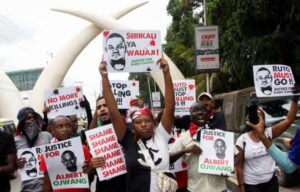
The shooting, combined with the revelations about Ojwang’s death, has triggered renewed calls for accountability. Human rights groups and foreign embassies have issued statements urging the Kenyan government to ensure transparency and justice.
On social media, hashtags like #JusticeForOjwang and #BonifaceKariuki have trended as Kenyans, especially youth, express fury at a system they say routinely silences dissent and targets the poor.
Activist groups have announced a planned “Total Shutdown” on Wednesday—a nationwide protest aimed at paralyzing economic activity to demand justice and mark one year since police opened fire on tax protests in 2023.
“We’ve been ignored too long,” said a youth organizer in Kisumu. “This isn’t just about Ojwang or Boniface. This is about the rot in the system that lets killers wear uniforms and call themselves protectors.”
As the investigations unfold, pressure is mounting on Kenyan authorities to act decisively. Public confidence in the police is at a low point, and leaders are being urged to not only prosecute individuals involved in abuses but to launch broader reforms.

