
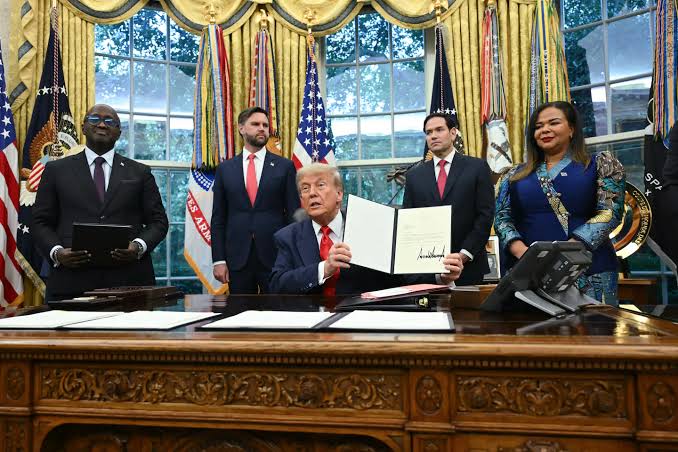
In a moment that many hope will end years of bloodshed, displacement, and mistrust, Rwanda and the Democratic Republic of Congo (DR Congo) signed a peace agreement in Washington on Friday, pledging to disengage from hostilities and chart a new course for stability in the troubled Great Lakes region.
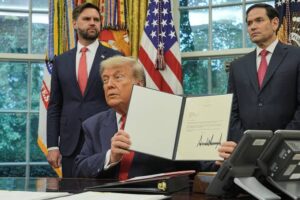
The agreement, described by US President Donald Trump as “a glorious triumph,” was signed at the US State Department by the foreign ministers of both nations, then formally endorsed in the Oval Office in a symbolic ceremony attended by Vice President JD Vance and Secretary of State Marco Rubio.
“This is a tremendous breakthrough,” President Trump declared, speaking with his trademark bravado. “The violence and destruction ends today, and the entire region begins a new chapter of hope and opportunity.”
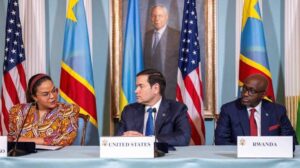
The peace accord calls for the disengagement, disarmament, and conditional integration of armed factions operating in eastern DR Congo, an area plagued by insurgencies for decades. Yet, despite the optimistic language and ceremonial gloss, the fine print remains closely guarded—raising questions about what has actually been agreed upon and whether it will hold.
Fragile Hope Amid a Troubled Past
This isn’t the first time the two neighbours have shaken hands over peace. Past deals, including those brokered by Angola and other regional actors, have fizzled out under the weight of distrust, competing interests, and on-the-ground complexities. Still, the Congolese presidency hailed this deal as “the most important diplomatic victory in more than 30 years.”
But even before the ink dried, cracks began to show.
A key sticking point is the presence of Rwandan troops—reportedly over 7,000 strong—on Congolese soil. Kinshasa has long accused Kigali of backing the M23 rebels, who in recent months seized key eastern cities including Goma and Bukavu, forcing thousands from their homes. Rwanda has denied these claims, insisting its military activity is strictly defensive, aimed at neutralizing the FDLR, a Hutu militia with ties to the 1994 Rwandan genocide.
Despite reports that DR Congo pushed for an immediate Rwandan withdrawal, Rwanda’s foreign minister Olivier Nduhungirehe firmly denied any such language in the final document. “The terms ‘Rwandan troops’ or ‘withdrawal’ do not appear in this agreement,” he said in a sharp statement just a day before the signing.
Congolese officials countered by saying the agreement calls for “disengagement”—a term they argue is broader and more diplomatic than “withdrawal” but with the same practical outcome.
Also, read: South Africa’s Top Police Chief Faces Fraud Charges
Behind the Scenes: Global Stakes and Strategic Bargains
This peace effort has not been without high-stakes bargaining. According to diplomatic sources, DR Congo turned to the United States for help after suffering significant territorial losses to M23 rebels. In return, Kinshasa reportedly offered Washington access to its abundant mineral wealth, including coltan, a vital material for electronics manufacturing.
Qatar also played a quiet but crucial role, dispatching envoys to both Kigali and Kinshasa and hosting early talks that laid the groundwork for the Washington agreement. It was after a high-level meeting in Doha between Presidents Félix Tshisekedi and Paul Kagame that momentum began to build toward Friday’s deal.
Even with this momentum, the agreement leaves key questions unanswered:
• Will M23 fighters actually disarm and leave occupied territories?
• What mechanisms will oversee the return of refugees and internally displaced persons?
• Who will lead the disarmament of the FDLR, a group that has survived previous attempts at neutralisation?
• Will humanitarian aid be granted access to rebel-held airports and zones?
A Cautious Public and a Weary Region
In both DR Congo and Rwanda, public reactions have ranged from cautious optimism to outright skepticism. In Goma, where families remain displaced and aid workers report growing humanitarian needs, residents said they’ve “heard this tune before.”
“We want peace, but real peace,” said Jeanne Kabemba, a teacher who fled with her children during the latest rebel advance. “Not just words in Washington.”
For now, the peace deal stands as a political win for Tshisekedi and a diplomatic scorecard entry for Trump. But as history has shown, peace in this part of the world isn’t declared at podiums—it’s built painstakingly, and tested in the hills and streets of eastern Congo.
The next few weeks will determine whether this deal marks a true turning point or becomes yet another footnote in a long list of broken promises.

