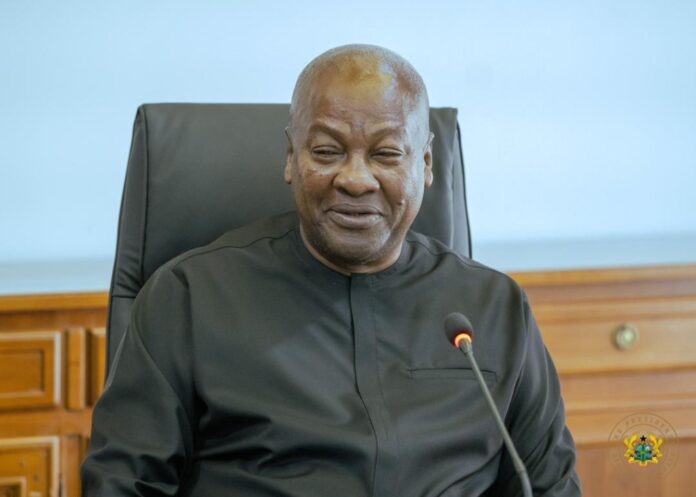
President John Mahama on Monday reflected on Ghana’s improving economic landscape, attributing the recent stability of the cedi to sweeping reforms in the country’s gold trade.
Speaking at the Jubilee House during a session with the Council of State, the President described how reining in a once chaotic sector has started to deliver real, tangible gains for Ghana’s economy.
“For years, we allowed the gold trade to run wild. It was practically a free-for-all, and as a result, we were getting only about 50 percent of what we were due,” Mahama stated. “But today, that’s changed—and the difference is showing up not just on paper, but in the pockets of the nation.”
At the heart of this transformation is the newly launched Gold Board, a regulatory body that now oversees gold exportswith the goal of maximizing national benefit. With tighter controls and new laws criminalizing unauthorized gold trading, the country’s gold revenue has more than doubled in recent months, according to Mahama.
And that uptick has had a ripple effect.
Thanks to increased earnings from gold exports, foreign exchange inflows into the Bank of Ghana have surged, allowing the country to maintain a healthy buffer. “We now have about six months of import cover,” the President told the Council. “That’s one of the strongest reserve positions we’ve had in years.”
Also, read: Congo Celebrates Customs Officer Recently Beatified by the Catholic Church
The stronger reserves have, in turn, propped up the cedi—a currency that has historically weathered extreme volatility. While Mahama acknowledged that broader reforms are still underway, he called the gold trade revamp a key early win in his administration’s larger “reset agenda”—a roadmap focused on restoring economic stability, tackling corruption, and rebuilding investor confidence.
Monday’s briefing wasn’t just about numbers. It was also about vision. Mahama noted that Ghana continues to lead on the African continent in the push for reparations—a subject the President will personally address at the upcoming African Union summit in Malibu.
“Ghana is a champion on reparations,” he said. “At the summit, I’ll be presenting a report that outlines our continued advocacy and the steps we believe Africa must take as a bloc.”
From monetary policy to historical justice, Mahama’s remarks underscored a presidency aiming to recalibrate the nation’s trajectory. And while the economic path ahead remains challenging, there is renewed belief—especially among policymakers—that Ghana’s wealth in resources, if managed well, can be turned into real prosperity.
For now, the gold that once slipped through Ghana’s fingers is beginning to serve its people in a more lasting way: by anchoring the currency, supporting the economy, and giving the cedi a chance to breathe.

