
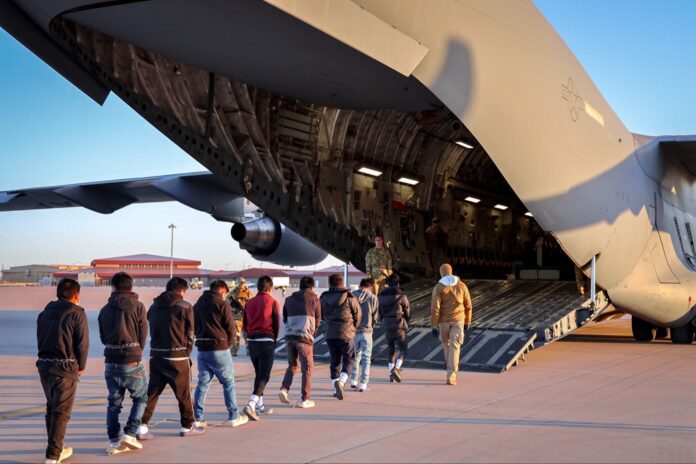
In a move that has reignited debate over America’s immigration policies, a U.S. deportation flight carrying a group of Asian migrants landed in Eswatini on Monday, marking the second such transfer under Washington’s expanding third-country deportation program.
The initiative, built on secretive bilateral agreements, allows the U.S. to send migrants from Asia and other regions to select African countries for detention or resettlement. While American officials insist the program improves “migration management,” rights advocates say it effectively outsources deportations to nations already grappling with human rights challenges.
Eswatini Receives Second Batch of Deportees

According to reports from the Associated Press, among those on the latest flight were two Vietnamese nationals. Eswatini’s prison authorities later confirmed the arrival of ten deportees, stating that they have been “securely accommodated” and pose no public threat.
However, the transfer has sparked outrage among local lawyers and human rights defenders. Attorney Mzwandile Masuku told the BBC he was “shocked and dismayed” that Eswatini accepted the migrants despite a pending court case over the first batch of arrivals.
Human Rights Watch also condemned the arrangement, revealing that the U.S.-Eswatini deal could see up to 160 migrants relocated in exchange for a $5.1 million payment aimed at “strengthening border and migration management capacity.”
Also, read: South Africa’s 337-Year-Old Mansion Sold For Record $3.2 Million
The Southern African Litigation Centre (SALC) has labeled the move unconstitutional, arguing that the government’s participation undermines Eswatini’s commitment to international human rights obligations. “We expected this moment to reflect a stronger rule of law and greater accountability,” said SALC’s Melusi Simelane.
An Expanding Network of Deportation Deals
Eswatini isn’t the only African nation participating in the U.S. initiative. Since July, at least 30 deportees have been flown to African countries, including South Sudan, Rwanda, and Ghana.
In South Sudan, six migrants reportedly remain in undisclosed detention facilities, while Rwanda has refused to disclose where its group is being held. Ghana, meanwhile, accepted 14 West African deportees earlier this year, sparking heated domestic debate and court challenges from affected families.
Despite the backlash, Ghana’s government defended the arrangement, claiming it was born of “strategic diplomacy” rather than financial incentive. The deal also appeared to yield quick diplomatic gains — the U.S. restored Ghana’s five-year multiple-entry visa privileges for visitors and four-year student visas shortly afterward.
African Governments Divided Over Hosting Migrants

Not all African governments have agreed to take part. Nigeria publicly rejected the idea of hosting non-Nigerian deportees, saying it would only accept verified citizens. Uganda, which was previously rumored to be part of the program, withdrew following intense international criticism.
Critics argue that the U.S. is exploiting weaker economies by offering financial aid to secure cooperation, turning African nations into “dumping grounds” for unwanted migrants from other continents.
“These deals risk creating a dangerous precedent,” said one African Union policy analyst. “They shift moral responsibility away from the U.S. and onto countries that are still struggling to uphold their own citizens’ rights.”
Mounting Pressure on Eswatini
Eswatini’s government now finds itself in an uncomfortable spotlight. The tiny southern African nation, already criticized for its record on political repression and lack of press freedom, must now explain how it intends to manage foreign deportees with limited infrastructure.
The ten Asian migrants recently received are being held in a maximum-security facility — the same one that houses four earlier arrivals from Cuba, Laos, Vietnam, and Yemen, who were transferred in July. Lawyers claim the detainees have been denied access to legal counsel and due process, further intensifying calls for transparency.
As more deportation flights are expected in the coming weeks, tensions are rising both within Eswatini and across the continent. Activists warn that the U.S. program risks igniting a humanitarian crisis while undermining Africa’s sovereignty.
For now, Eswatini remains at the center of a global controversy — one that pits Washington’s migration politics against Africa’s struggle to assert its independence in matters of human rights and diplomacy.

