
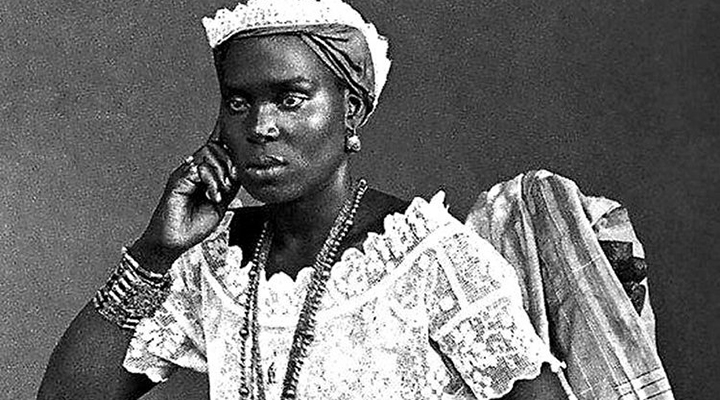
Throughout African history, there have been many stories of valiant men and women who fought against slavery and colonization.
One such story is that of Aqualtune, a princess from Angola who played a significant role in the fight against Portuguese colonialism and the transatlantic slave trade. Her extraordinary bravery and strength have made her a legendary figure in African history.
Aqualtune was born in the early 17th century in Angola, a country located in southwestern Africa. At the time, Angola was under Portuguese colonial rule and was a major source of slaves for the transatlantic slave trade.
Aqualtune was the daughter of an Angolan king and was born into a royal family. Her father was the king of the kingdom of Kongo, which was one of the most powerful states in central Africa.
Aqualtune grew up in a time of great upheaval in Angola. The Portuguese had established a strong presence in the country and were engaged in a brutal campaign to enslave the local population.
Aqualtune’s father was among the African rulers who resisted the Portuguese, and he was eventually captured and executed by the colonizers. Aqualtune was also captured by the Portuguese and sold into slavery.
Despite being enslaved, Aqualtune did not give up her fight against the Portuguese. She managed to escape and fled to Brazil, where she became the leader of a resistance movement of escaped slaves known as quilombos.
These communities were formed by escaped slaves who established their own independent settlements in remote areas. Aqualtune became the leader of one such settlement, which was located in the state of Pernambuco in northeastern Brazil.
Under Aqualtune’s leadership, the quilombo became a symbol of resistance to slavery and Portuguese colonialism. The settlement was attacked several times by Portuguese troops, but Aqualtune and her followers were able to repel the attacks and maintain their independence.
Aqualtune became a legendary figure in Brazil, and her story inspired many other enslaved Africans to resist their captors.
Despite her fame and success, Aqualtune’s life came to a tragic end. She was eventually captured by the Portuguese and was executed along with several other leaders of the quilombo.
Her legacy, however, lives on. Today, she is remembered as a symbol of resistance and resilience in the face of oppression.
In this article, we will delve deeper into the life and legacy of Aqualtune. We will explore her early years in Angola, her capture and enslavement, and her leadership of the quilombo in Brazil.
We will also examine how Aqualtune came to represent resistance to slavery and Portuguese colonialism in both Angola and Brazil.
Through Aqualtune’s story, we will gain a better understanding of the struggles and triumphs of enslaved Africans and their descendants.
We will see how even in the face of obstacles, people like Aqualtune were able to fight for their freedom and dignity. We will also gain a greater appreciation for the importance of remembering our collective past and the lessons that can be learned from it.
Early Life of Aqualtune
Aqualtune was born in the early 17th century in the Kingdom of Congo, which was located in present-day Angola.
Her father, Prince Kiluanji kia Samba, was a prominent political leader who ruled the Mbundu people in the northern region of Angola.
Aqualtune was born into a royal family and grew up in a wealthy and influential household. She received a formal education and learned how to read and write in Portuguese, the language of the colonizers.
The Kingdom of Congo was a prosperous and powerful state, with a long history of trade and diplomatic relations with European powers.
However, in the late 16th century, the Portuguese began to establish a foothold in Angola, seeking to expand their control over the region and exploit its resources.
The Portuguese brought with them Christianity and the slave trade, which had a profound impact on the social and economic fabric of the region.
The Kingdom of Congo, which had a complex social structure and a strong centralized government, resisted Portuguese influence, but its power was weakened by internal strife and European military superiority.
Capture and Enslavement of Aqualtune
In 1626, Aqualtune’s father was defeated and killed in battle by the Portuguese army, and her mother was taken captive.
Aqualtune, along with her children and other members of the royal family, was also captured and taken as a slave.
She was taken to Brazil, where she was sold into slavery and forced to work on a plantation. Despite her captivity, Aqualtune remained committed to her people’s liberation and actively sought ways to resist slavery and colonialism.
Battle of Mbwila
The Battle of Mbwila, which took place in 1665, is remembered as a significant occasion in Central African history.
The Portuguese, who sought to enlarge their dominion and tame the native populace, were opposed by the Kingdom of Kongo.
Princess Aqualtune, a courageous and accomplished leader, oversaw an army of 10,000 men and women. Her military knowledge, leadership, and planning were crucial in setting up the war against the Portuguese.
Princess Aqualtune led her army with courage and tenacity, but the Portuguese dealt a crushing blow to it.
The fight was a bloody and brutal conflict that seriously damaged the Kingdom of Kongo. A large number of Aqualtune’s warriors were either slain or captured, and King Antonio I was decapitated.
Thousands of people, including her three children and the Princess Aqualtune herself, were captured.
Princess Aqualtune was sold into slavery at the Port of Recife after their arrival in Brazil as a breeding slave.
At the Santa Rita plantation in the Portuguese Captaincy of Pernambuco, which was ruled at the time by the Dutch, her three children, Ganga Zumba, his brother Zona, and his sister Sabina (who was the mother of Zumbi dos Palmares), were turned into slaves.
Princess Aqualtune’s three children, including Ganga Zumba, rebelled against their rulers after being sold into slavery in Brazil as a breeding slave and fled to the Quilombo dos Palmares, a sizable Maroon village that housed many fugitive slaves.
She was made to live out the rest of her days as a breeding slave, with the only thing that made her valuable being her progeny.
Aqualtune, in a brave and daring action, broke free from her captivity and made her way to Quilombo dos Palmares, where her son Ganga Zumba was the leader.
Aqualtune discovered freedom and safety in this society, which offered refuge to enslaved Africans who had escaped their oppressors.
Quilombo Palmares
Between the middle of the 16th century and the middle of the 17th century, enslaved Africans who had fled their captors found refuge and resistance at Quilombo dos Palmares, a community of runaway slaves in colonial Brazil.
The initial settlement was established in the late 16th century by Ganga Zumba and a group of runaway slaves.
Over time, the settlement expanded to include numerous villages and thousands of residents. Due to its adamant resistance to slavery and commitment to African traditions and culture, Palmares rose to prominence.
The appearance of Princess Aqualtune on Palmares was significant for the town. She rose to prominence in the Subupuira quilombo and helped the locals fend off Portuguese incursions by applying her knowledge of Kongo warfare strategies.
In order to create a network of resistance against the Portuguese conquerors, Aqualtune formed ties with other quilombos and indigenous groups.
People around her admired and respected her for her leadership and commitment to the welfare of her people. She continued to play a crucial role in her people’s fight for freedom to the very end.
Resistance and Legacy
Aqualtune’s legacy lies in her resistance against slavery and her commitment to the liberation of her people.
While in Brazil, she became a leader among the enslaved population, organizing resistance and rebellion against their masters.
She also established networks of communication and solidarity among the slaves, spreading messages of hope and freedom.
According to some accounts, Aqualtune led a revolt against her plantation owners, which resulted in her capture and execution.
Despite Aqualtune’s undetermined cause of death in 1675, her courage, tenacity, and commitment to justice inspired future generations.
Her children continued her tradition and had a big impact on the Brazilian anti-colonialism struggle. Zumbi dos Palmares, her great-grandson, rose to prominence in the Brazilian Black community as a leader in the resistance struggle and a source of inspiration.
Aqualtune’s resistance against slavery and colonialism inspired generations of Africans to fight against oppression and injustice.
Her legacy has been celebrated in art, literature, and music, and she remains an icon of African resistance against slavery and colonialism.
In Angola, she is honored as a national hero and a symbol of the country’s struggle for independence.
Conclusion
Aqualtune’s life and legacy represent the resilience and determination of the African people in the face of oppression and injustice.
Her story reminds us of the atrocities committed during the transatlantic slave trade and the ongoing struggle against racism and inequality.
Aqualtune’s bravery and commitment to justice serve as an inspiration to all those who fight for freedom and equality.
Also read: 10 African Tribes with Significant Impact on the Transatlantic Slave Trade
As we continue to work towards a more just and equitable world, we must remember the stories of those who came before us and draw strength from their struggles and triumphs.
Aqualtune’s legacy lives on, reminding us of the power of resistance and the resilience of the human spirit.
Source

