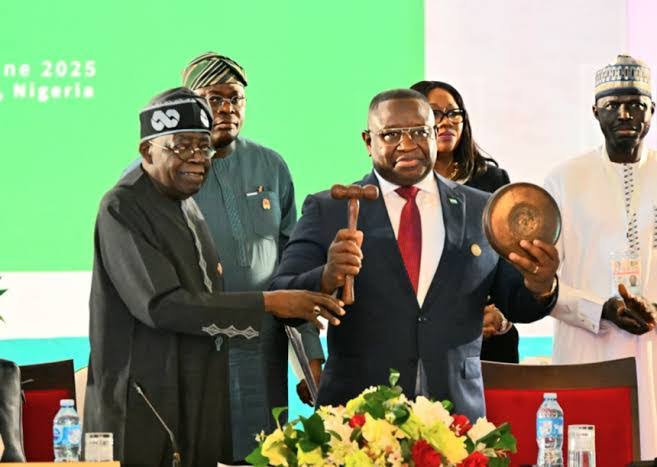
Nigerian President Bola Ahmed Tinubu has officially concluded his tenure as chairman of the Economic Community of West African States (ECOWAS), handing the baton to Sierra Leone’s President Julius Maada Bio at the conclusion of the ECOWAS Heads of State and Government Summit held in Abuja.
The transition comes at a pivotal moment for the regional bloc, which is grappling with some of its most severe tests to date — from democratic backsliding and security threats to a shrinking membership. Tinubu, who took over the ECOWAS chairmanship in July 2023 and was reappointed for a second term in 2024, saw his leadership bookended by efforts to safeguard democratic governance in a region increasingly marked by coups and civil unrest.
In his farewell address, President Tinubu expressed gratitude to his peers for their trust during his two-term leadership, emphasizing the importance of continued collaboration.
“As we look forward to the future of West Africa,” he said, “I remain positive that with the continued cooperation of all its members, ECOWAS will scale over greater heights in our collective pursuit of peace, security, stability, and prosperity for our people and for our region.”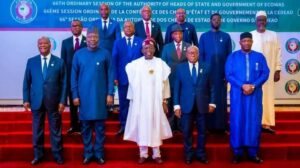
Tinubu’s time as ECOWAS chair was anything but smooth sailing. His leadership coincided with a sharp uptick in political instability across West Africa, including the withdrawal of Burkina Faso, Mali, and Niger from the bloc, a move that shocked observers and weakened ECOWAS’s influence. The three nations, all led by military juntas, went on to form their own coalition, the Alliance of Sahel States (AES), which now operates in direct defiance of ECOWAS’s authority.
From the start, Tinubu was outspoken in his push for a return to civilian rule across the region. Under his watch, ECOWAS imposed sanctions and led mediation efforts in countries plagued by coups and unconstitutional transitions of power. But as time went on, his tough-love approach, viewed by some as necessary and by others as heavy-handed, often hit a wall of resistance.
By January 2025, the bloc’s cohesion had visibly fractured, with the AES’s full withdrawal marking a low point in regional unity. While ECOWAS under Tinubu maintained a consistent message of zero tolerance for military rule, its capacity to enforce decisions was increasingly questioned.
Now, as President Julius Maada Bio assumes the rotating chairmanship, the expectations are high and the challenges, daunting.
Also, read: Trump Declares End To Rwanda–DRC Conflict With Landmark Peace Deal
In his first address as chairman, Bio struck a tone of reconciliation and focus, outlining four key priorities: restoring constitutional order and deepening democracy, revitalizing regional security cooperation, advancing economic integration, and building institutional trust across ECOWAS structures.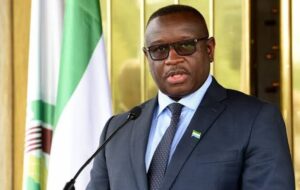
“West Africa is at a crossroads,” Bio said. “But I believe we can turn the tide not just through statements and sanctions, but by rebuilding bridges and delivering tangible results for our people.”
Observers note that Bio, a former military leader turned democratically elected president, may bring a unique blend of understanding and credibility in engaging both civilian governments and military-led regimes.
Beyond diplomacy, Bio will also be tasked with reviving ECOWAS’s long-stalled economic initiatives, particularly the dream of a single regional currency, which has suffered multiple delays. The bloc’s trade integration efforts have also faced headwinds, further complicated by political divisions and logistical gaps across member states.
Despite the setbacks, ECOWAS remains a key force in shaping West Africa’s future and with new leadership at the helm, many hope this moment marks the beginning of a healing process.
For Tinubu, who now returns full focus to domestic affairs in Nigeria, his ECOWAS legacy will likely be remembered as one of urgency, resistance, and persistence, a tenure shaped by crisis, but defined by an unwavering commitment to democratic ideals in a region struggling to hold onto them.

