
Ghana’s economy has shown stronger-than-expected momentum in the first quarter of 2025, recording a 5.3% year-on-year growth and beating earlier projections, according to a new analysis by IC Research. The unexpected growth has sparked cautious optimism that the country may outperform its full-year economic forecasts, despite ongoing fiscal tightening.
Originally, economists had penciled in growth between 4.5% and 4.8% for the year, with much of the attention focused on how government budget cuts might limit expansion. But the latest data suggests that the Ghanaian economy is not only withstanding the pressure, it’s finding ways to thrive in spite of it.
In its report titled “Ghana’s Q1 2025 Real GDP Growth: Green Shoots in Tight Soil”, IC Research detailed how economic activity picked up pace in the first three months of the year, outstripping the 4.9% growth recorded in the same quarter of 2024. The gains came even as the government moved to rein in spending and stabilize public finances.
“We foresee full-year 2025 overall growth likely exceeding our upper-band forecast of 4.8%,” the report noted. However, the analysts added a note of caution, saying they would maintain the current growth range of 3.8% to 4.8% until the fiscal impact of the second quarter becomes clearer.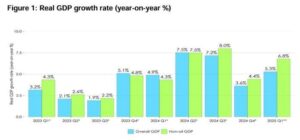
Non-Oil Sector Fuels the Surge
Perhaps the most encouraging sign for analysts was the 6.8% year-on-year growth in the non-oil sector — a clear indication that Ghana’s real economy is driving growth from within. This expansion came even as the oil and gas sector experienced a contraction during the same period.
Also, read: Civilians Caught in Crossfire as Trump’s Drone War Escalates in Somalia—Report Says
“This reflects strong underlying momentum in the real economy and has significantly boosted our optimism about Ghana’s growth outlook for 2025,” the report said. It added that while fiscal tightening remains a downside risk, the broad-based strength in key non-oil sectors bodes well for the rest of the year.
Which Sectors Drove the Growth?
Several sectors showed double-digit or near double-digit growth, painting a picture of a diversified economy finding its stride:
• Fishing: 16.6%
• Information and Communication Technology (ICT): 13.1%
• Finance and Insurance: 9.3%
• Transport and Storage: 8.6%
• Trade: 7.1%
• Crops and Cocoa: 6.7%
• Manufacturing: 6.6%
These sectors not only contributed to GDP growth but also reflected increasing resilience and innovation across different layers of the economy.
Agriculture: The Quiet Powerhouse
One of the quiet but powerful drivers of growth came from the agriculture sector, which expanded by 6.6%. The key factor? A strong 6.7% jump in the high-weight crops sub-sector.
IC Research credited this growth with helping to steadily ease food inflation — a major concern for households and policymakers alike. “We note that the impressive performance in the crops sector has yet to reflect the government’s ongoing investments in agriculture,” the report highlighted. “Those investments are expected to deepen impact over time and further support lower food inflation.”
Looking Ahead: Growth with Caution
Despite the impressive start to the year, IC Research remains careful in its outlook. The lingering effects of fiscal tightening — necessary to stabilize the macroeconomic environment — could dampen momentum in subsequent quarters.
Still, for now, the report offers a breath of fresh air for Ghanaians, many of whom have weathered years of economic uncertainty. The strong Q1 showing has renewed hope that Ghana could be on course for a better-than-expected 2025.

