
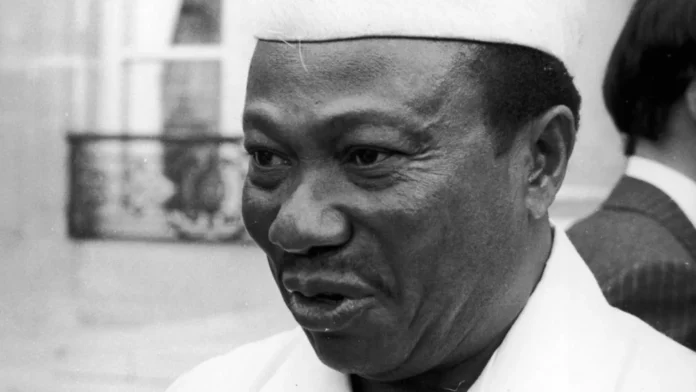
A heavy silence fell over Liberia’s capital on Tuesday as the nation gathered to confront a 45-year-old wound that never truly healed. For the first time since the 1980 military coup that upended the country’s leadership, former President William R. Tolbert and 13 of his senior officials received symbolic state funerals — a belated but powerful gesture of remembrance, reconciliation, and collective reckoning.
President Joseph Boakai, who led the somber ceremony in Monrovia, called the event “an act of national conscience,” saying it was time Liberia faced its violent history with “truth, justice, and reconciliation.”
Tolbert, whose nine-year presidency ended abruptly on April 12, 1980, was brutally murdered during a coup staged by 28-year-old Master Sergeant Samuel Doe. The young sergeant’s takeover ended more than a century of Americo-Liberian political dominance and marked the beginning of Liberia’s descent into years of political unrest and civil war.

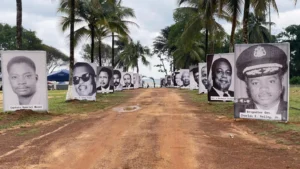
In the days following the coup, 13 members of Tolbert’s cabinet — including Foreign Minister Charles Cecil Dennis and Justice Minister Joseph Chesson — were dragged before what many have called a “kangaroo court,” then publicly executed by firing squad on a beach near Monrovia. Their bodies were reportedly dumped in a mass grave. Until now, they were remembered only by a commemorative tombstone near the barracks where they were killed — a monument that bore no actual remains.
Tuesday’s ceremony did not offer physical closure, no bodies were recovered. The grave dug for the reburial was left unsealed, left open in case the remains are one day found. But for the families, it was a step forward.
“It has been 45 years and the pain is still fresh,” said Yvette Chesson-Gibson, daughter of Justice Minister Chesson. “This is not just a ceremony. It is the beginning of closure. Reconciliation is not an event.”
The solemn tribute included the presentation of Liberian flags to each of the victims’ families, honoring their public service. In place of the traditional 21-gun salute — which would have echoed the very violence that stole these lives — 21 trumpets sounded across the crowd, offering a dignified, humanized farewell.
Also, read: ‘Life Support Was Turned Off,’ Report Says as Kenyan Vendor Shot by Police During Protests Dies
“Our fathers were murdered in one of the world’s most despicable and inhumane public acts,” said Bindu Dennis, daughter of Foreign Minister Charles Dennis. “This was an ugly spirit of greed for political power. But closure does not mean forgetting. It means honoring and learning.”
The ceremony also referenced Doe’s own violent end. After ruling Liberia for a decade, Doe was captured, tortured, and killed by rebel forces in 1990. His body, too, was finally reburied in his hometown just last week, in another symbolic act of national healing.
President Boakai, who signed an executive order last year to establish a war crimes court, used both funerals to amplify his message that Liberia must no longer run from its past.
“This is not just a burial,” he said at Doe’s reinterment. “It is a time to reconcile with our history, to heal from our wounds, and to remember with respect and purpose.”
Liberia’s path to justice remains unfinished. A Truth and Reconciliation Commission (TRC), established in 2006, compiled harrowing testimonies from survivors of the country’s civil wars and named individuals for prosecution in 2009. But in the years since, no one has faced trial on Liberian soil. Some perpetrators have been convicted abroad, but domestically, justice has remained elusive.
Jarso Maley Jallah, the minister overseeing the reburial programme, acknowledged the difficulty of the moment. “There are some things that have happened in our country that we’re not proud of,” she said, “but yet we are Liberians, and we must come together to advance our nation.”

