
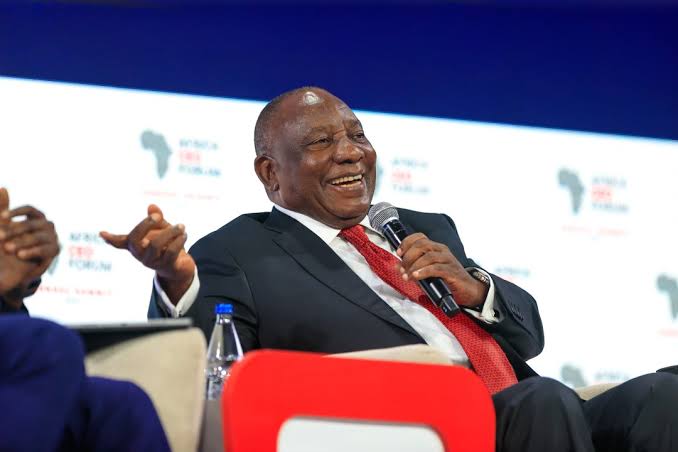
South African President Cyril Ramaphosa has publicly rejected the asylum claims of 59 white Afrikaners who recently arrived in the United States under refugee status, calling the situation “deeply troubling” and a distortion of the country’s democratic journey.
In a candid interview with CNN’s Larry Madowo at the African CEO Forum, Ramaphosa made it clear that the individuals do not meet the internationally recognized definition of refugees, and urged the U.S. government—particularly President Donald Trump—to engage in deeper diplomatic discussions on the matter.
“These are not people fleeing persecution,” Ramaphosa said firmly. “They are not being hunted or harassed for their beliefs, their politics, or their race. They are simply uncomfortable with the democratic changes our country has embraced since the fall of apartheid.”
The 59 Afrikaners, who were recently admitted into the U.S. under a refugee program, claim they are victims of racial discrimination in post-apartheid South Africa. Their case has gained support from far-right voices in the United States, including President Trump, who has previously echoed claims that white South Africans face systematic violence.
Ramaphosa, however, sees it differently. “I spoke with President Trump about this directly,” he said. “He asked me, ‘What is happening down there?’ I told him: the stories he’s hearing are from those who oppose South Africa’s transformation agenda. They do not reflect the reality of our country.”
The president expressed concern that the refugee claims are being weaponized by anti-democratic elements to discredit South Africa’s post-apartheid progress. “These individuals belong to a fringe minority who resist the very idea of an inclusive South Africa. Their discomfort with change does not qualify them as refugees,” he stated.
He also pointed out a unique fact about the country’s history: “South Africa is perhaps the only nation on the continent where colonizers remained and became part of the national fabric. Our Constitution demands inclusion, and we are committed to that vision.”
Also, read: US Court Reduces Ghanaian Journalist’s $18 Million Defamation Win to Just $500
Ramaphosa warned that narratives suggesting white South Africans are under siege only serve to unravel the nation-building efforts that leaders like Nelson Mandela fought for. “I would never take this country back to apartheid. I studied at the feet of Mandela—we are moving forward, not backward,” he emphasized.
Though he voiced frustration over the U.S.’s handling of the situation, Ramaphosa signaled his openness to continued dialogue. “I believe in diplomacy. I hope to meet with President Trump again to discuss this directly. It’s important we set the record straight.”
South Africa’s government has consistently denounced claims of racial persecution against whites, describing such assertions as politically motivated and divorced from the facts on the ground. While acknowledging challenges in the country, Ramaphosa maintained that efforts to redress historical injustices are rooted in constitutional law, not racial vendettas.
As the conversation around the Afrikaners’ asylum status continues to stir debate in both countries, Ramaphosa’s message was unmistakable: South Africa’s transformation is not persecution—it is progress. And those unwilling to embrace it are not victims of it.

