
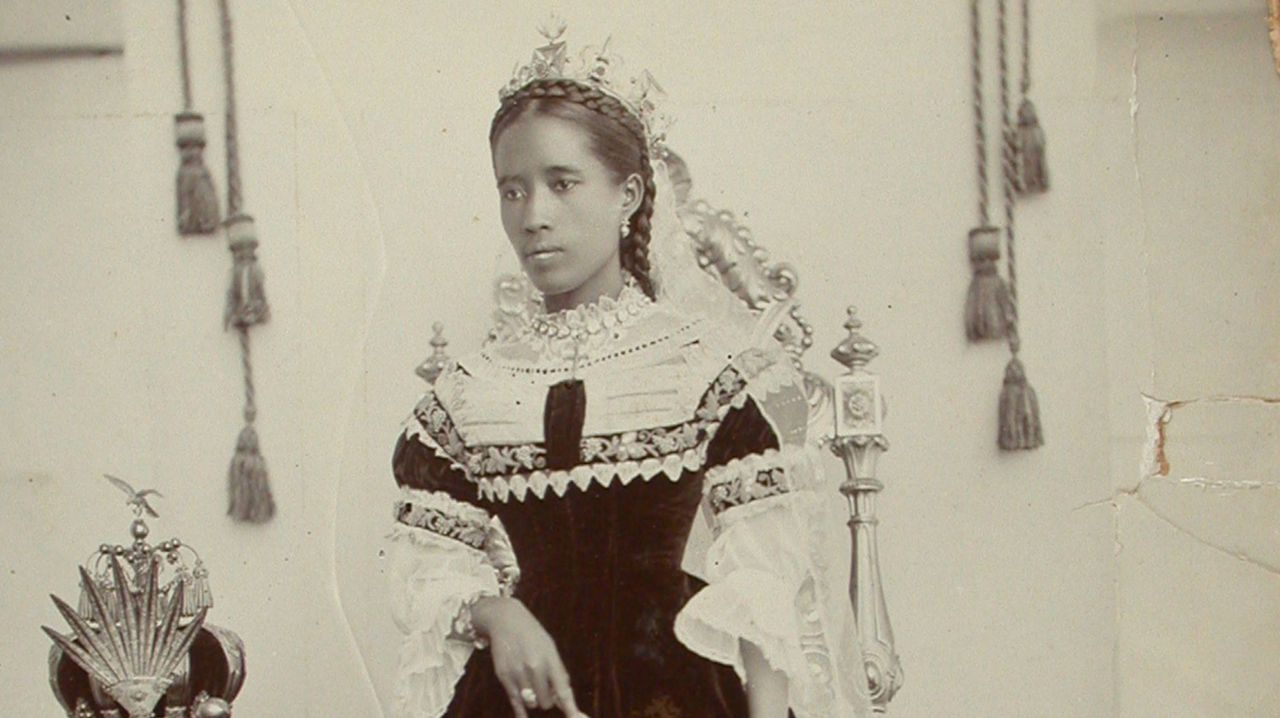
Ranavalona III was the last queen of the Kingdom of Madagascar whose reign was marked by her valiant but ultimately unsuccessful efforts to resist French colonization.
Her political marriage to Rainilaiarivony, a member of the Hova elite, helped her oversee the governance of the kingdom and manage foreign affairs.
Despite her attempts to strengthen trade and diplomatic relations with foreign powers, French attacks led to the fall of the kingdom and her exile to Réunion and later to Algiers, where she died at the age of 55.
Despite her tragic end, Ranavalona III remains a revered figure in Malagasy history, remembered for her bravery and resistance against colonialism.
In this article, we will delve deeper into the life and reign of Ranavalona III, exploring her struggles, triumphs, and legacy.
We will examine the political and social context of Madagascar during her reign, the challenges she faced as a female ruler, and her efforts to resist French colonization.
We will also analyse the impact of her reign on Madagascar’s history and culture, and discuss the lasting significance of her legacy today.
Early life of Ranavalona III
Ranavalona III, the last sovereign of the Kingdom of Madagascar, was born as Princess Razafindrahety on 22 November 1861.
She was the daughter of Andriantsimianatra and Princess Raketaka, who were cousins.
Being the niece of Queen Ranavalona II and the great-granddaughter of King Andrianampoinimerina, Razafindrahety was eligible to inherit the throne of the Kingdom of Madagascar.
Her parents entrusted the care of the infant princess to a slave who served the family.
As she grew up, Razafindrahety was sent to her aunt, Queen Ranavalona II, for her education.
The queen ensured that she received a private education from a teacher from the London Missionary Society (LMS).
Razafindrahety was known as an industrious and curious child with a great love for studying the Bible, learning, and reading.
She developed a strong relationship with her teachers and continued her education at various schools, including the Congregational School of Ambatonakanga, the Friends High School for Girls, and the LMS Girls’ Central School.
She was baptized as a Protestant at Ambohimanga on 5 April 1874, and her teachers consistently praised her as one of their best students.
As a young woman, Razafindrahety married an Andriana nobleman named Ratrimo.
However, her husband died a few years later at the age of 22, leaving her a widow.
There were rumors that Prime Minister Rainilaiarivony, who was instrumental in the political marriage between the ruling queen and the prime minister, had Ratrimo poisoned for political reasons.
Rainilaiarivony’s older brother, Prime Minister Rainivoninahitriniony, had orchestrated the Aristocratic Revolution of 1863, which replaced the absolute rule of the Andriana with a constitutional monarchy where power was shared between an Andriana monarch and a Hova (freeman) prime minister.
The political marriage was meant to cement this arrangement, and it was believed that Rainilaiarivony had Ratrimo poisoned so that Razafindrahety would be free to marry him and succeed to the throne.
Ranavalona III reign as a monarch
Ranavalona III became queen of Madagascar after the death of her predecessor, Queen Ranavalona II, on 13 July 1883.
She was coronated on her 22nd birthday in the Mahamasina neighborhood of Antananarivo, where she broke tradition by supplementing the customary retinue of soldiers with 500 male and 400 female pupils from the capital’s best schools.
Her role as queen was largely ceremonial, and she frequently delivered speeches on behalf of her prime minister and made public appearances to inaugurate new buildings.
Ranavalona’s political marriage with Prime Minister Rainilaiarivony continued the tradition of political marriages between the monarch and the prime minister.
However, the prime minister held the majority of political power, and Ranavalona’s aunt, Ramisindrazana, acted as her adviser and exercised considerable influence at court.
Her older sister, Rasendranoro, and her children also lived with her at the Rova and were close companions.
Ranavalona enjoyed leisurely activities such as flying kites, playing lotto, and knitting.
She had a great love for fine garments and most of her clothing were imported from Paris.
She even invited a French stage magician, Marius Cazeneuve, to perform at her court.
Reportedly, the queen and Cazeneuve developed a romantic relationship, and the magician was also working for French intelligence, promoting French influence at court.
Ranavalona III Role During the Franco-Hova War
Ranavalona III, the sovereign of Madagascar, found herself in the middle of a power struggle between France and Britain that had been brewing for over a century.
In the three years before her coronation, tensions between France and Madagascar had escalated, with French attacks on the northwestern coast, the occupation of Mahajanga, and the bombardment and capture of Toamasina.
To defend Madagascar, Prime Minister Rainilaiarivony enlisted the help of Digby Willoughby, a British military expert.
Despite ongoing negotiations between Madagascar and France, the two sides were unable to reach a compromise.
In December 1885, a French column brought an ultimatum to Antananarivo, which was ratified by Ranavalona and Rainilaiarivony in January 1886.
The treaty was later published in Paris without an annex explaining certain articles, which led to confusion about the terms.
France declared a protectorate over Madagascar despite the opposition of the Malagasy government.
The international community had mixed reactions to France’s actions, with Britain unwilling to defend Madagascar for fear of retaliation and the United States and Germany continuing to deal directly with the queen’s government.
In 1886, Ranavalona tried to solicit support from the United States, but to no avail.
In 1887, she signed another treaty granting further concessions to France.
France’s claim to Madagascar as a protectorate was recognized by Britain in 1890.
The French then aggressively claimed territorial rights established by the treaty, which was perceived by Ranavalona and Rainilaiarivony as an encroachment on Malagasy sovereignty.
Diplomatic relations were broken off in 1894, and the French bombarded and occupied Toamasina and Mahajanga.
Over 6,000 French soldiers died from disease during their advance, and the main troops reached the capital in September 1895.
After three days of fighting, Ranavalona agreed to surrender her kingdom to the French upon their bombardment of the Rova palace compound with heavy artillery.
In 1896, France annexed Madagascar and declared it a colony, exiling Prime Minister Rainilaiarivony to Algeria.
The queen and her administration were left without real political power, and Ranavalona was approached by a French official to select a new prime minister.
She believed she would have to marry the new prime minister but was reassured by the official that France had no intention of imposing a husband on her.
In December 1895, the menalamba rebellion emerged against French rule and was effectively put down by the French military at the end of 1897.
Many leading figures were executed, and the government of France replaced the island’s civil governor with a military governor.
Queen Ranavalona was required to present herself and her entourage at the military headquarters, sign documents handing over all royal property to France, and was placed under arrest and imprisoned in her own palace.
She was only allowed to receive visitors who had obtained prior authorization from the military governor.
Ranavalona attempted to convert to Roman Catholicism to curry French favor but was informed that such a gesture was no longer necessary.
On February 27, 1897, Gallieni exiled Ranavalona from Madagascar and abolished the monarchy the next day.
French officials ordered the queen to leave her palace, and she was carried by palanquin accompanied by around 700-800 escorts and porters while the city slept.
During her journey to the eastern port of Toamasina, where she would board a ship to Réunion, Ranavalona reportedly consumed alcohol heavily.
Later on, she was informed that her sister Rasendranoro and aunt Ramasindrazana were also arriving, as well as her fourteen-year-old niece Razafinandriamanitra, who was pregnant with the child of a French soldier.
Death of Ranavalona III
After being denied two requests to return to Madagascar due to insufficient funds, Ranavalona III passed away in Algeria on 23 May 1917.
Her funeral was attended by many admirers and prominent figures, but the French colonial administration showed neglect towards her memory by refusing to refurbish her tomb.
Eight years after her death, the Governor-General of Algeria requested that the colonial government in Madagascar provide funds for the upkeep of her tomb, but the request was refused twice.
In November 1938, her remains were exhumed and re-interred in the tomb of Queen Rasoherina at the Rova of Antananarivo.
However, a fire severely damaged the royal tombs in 1995, with the remains of Ranavalona III being the only ones that could be saved. Her remains were then re-interred in the royal tombs at Ambohimanga.
Ranavalona’s aunt Ramasindrazana left Algeria after her death and moved to Alpes-Maritimes, while her heir-apparent Marie-Louise left her villa to study at a French high school and later married Andre Bosshard.
Also read: Aqualtune, the Angolan Princess Who Fought Against Slavery
Despite receiving a pension from the French government, Marie-Louise pursued a career in nursing and was awarded the Legion of Honor for her medical services during World War II.
After divorcing Bosshard without any descendants, she lived the rest of her life as a flamboyant and vivacious socialite until passing away in Bazoches-sur-le-Betz on 18 January 1948. Ranavalona III was buried in Montreuil, France.
Source

