
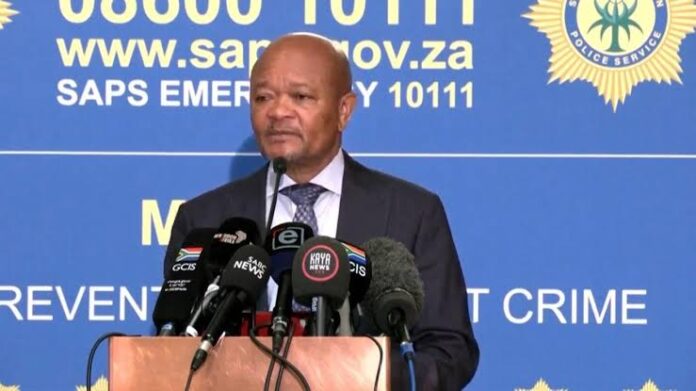
South Africa’s Police Minister Senzo Mchunu has come out strongly against President Donald Trump’s claims that the country is witnessing a “genocide” against white farmers, stating that the U.S. president twisted facts to support a misleading narrative.
This comes after a meeting between Trump and South African President Cyril Ramaphosa at the White House on Wednesday, during which a video was shown in the Oval Office depicting a rural scene with rows of white crosses. Trump pointed to the image and claimed the crosses were burial sites for more than a thousand white farmers killed in South Africa, adding, “These are burial sites… over a thousand… and those cars are lined up to pay love on a Sunday morning.”
But Mchunu, speaking at a press briefing in Johannesburg on Friday, called out the claim as completely false.
“Those are not graves. They never were,” Mchunu clarified. “That video shows a temporary protest memorial from 2020. It was set up to draw attention to attacks on farmers—Black and white—after the murder of a white couple during a farm robbery.”
The police minister emphasized that the symbolic crosses were part of a peaceful demonstration held near Newcastle in KwaZulu-Natal and were taken down after the event. He said even the family of the murdered couple and community members involved in the procession confirmed that the display was not intended to resemble burial sites.
Trump’s comments, according to Mchunu, are part of a growing effort by the U.S. president to portray violence in South Africa as a targeted campaign of racial extermination against whites—a claim South African officials have firmly rejected.
“We respect the office of the President of the United States,” Mchunu said. “But we cannot respect a story that suggests there is a genocide against white South Africans. That’s simply not true, and it’s dangerous rhetoric.”
The statistics support Mchunu’s position. From January to March of this year, South Africa recorded more than 5,700 homicides. Of these, six occurred on farms—only one of which involved a white victim.
While South Africa does struggle with high levels of violent crime, farm attacks make up a small portion of those incidents. Both Black and white farmers have been targeted, and the government has publicly condemned violence against all communities.
Also, read: Ghana Eyes $12 Billion Annual Windfall from Small-Scale Gold Mining Surge
Whites in South Africa, who make up about 7% of the population, still dominate the country’s wealthier commercial farming sector—an enduring legacy of apartheid-era inequalities that officially ended more than three decades ago. But that reality, Mchunu said, should not be manipulated into a false narrative.
Lourens Bosman, a former member of Parliament who was present at the 2020 procession, also weighed in. He explained that the crosses were meant to honor all farmers and farmworkers who had lost their lives since 1994—regardless of race. “It was a call for unity and safety in rural communities, not a racial grievance,” Bosman said.
Despite this, the Trump administration stood by the video’s inclusion. When questioned about Mchunu’s rebuttal, White House Press Secretary Karoline Leavitt doubled down, stating, “The video showed crosses that represent the dead bodies of people who were racially persecuted by their government.”
President Ramaphosa reportedly requested the meeting with Trump in a bid to repair diplomatic tensions and challenge what he described as growing “misconceptions” about South Africa’s internal affairs. The South African government has repeatedly asked that political leaders abroad not exploit isolated acts of violence to stoke racial fears.
“There are real problems in this country,” Mchunu acknowledged. “But let us solve them with facts—not fiction.”
As South Africa continues to battle crime, inequality, and social unrest, officials warn that international leaders spreading misinformation could do more harm than good to both diplomatic relations and public discourse.

