
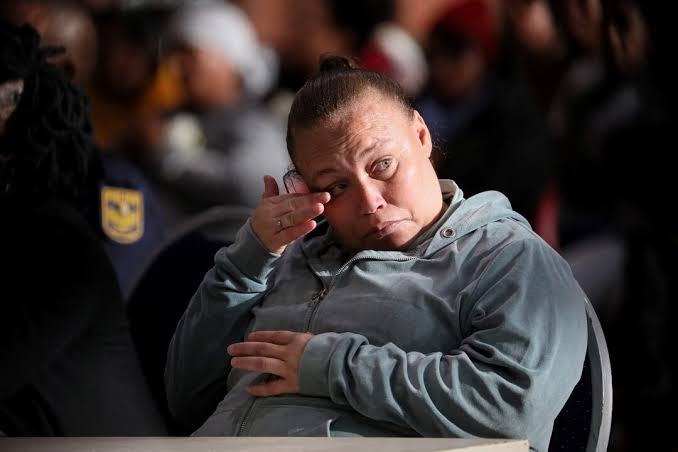
In a case that has left South Africa heartbroken and outraged, a mother and her two accomplices have been sentenced to life in prison for trafficking her six-year-old daughter—an act the presiding judge described as “unredeemable.”
Kelly Smith, along with her boyfriend Jacquen Appollis and their friend Steveno Van Rhyn, were handed the maximum sentence by a high court in the Western Cape on Thursday. The trio was convicted of kidnapping and trafficking Smith’s daughter, Joshlin Smith, who vanished from her home in Saldanha Bay in 2024. Her whereabouts remain unknown.
The harrowing case has captured the nation’s attention since the little girl went missing. What started as a desperate search soon evolved into a national tragedy as details of the crime unfolded. In chilling testimony, a witness revealed that Kelly had confided in her about selling her own daughter to a traditional healer, known locally as a sangoma, for 20,000 rand—roughly $1,100. The girl, according to the witness, was allegedly targeted for her “eyes and skin.”
Joshlin’s body has never been found, despite extensive police efforts that spanned months and mobilized entire communities. Her disappearance struck a deep chord in the country, where child trafficking has long been a hidden crisis but rarely prosecuted with such visibility.
Delivering his verdict, Judge Nathan Erasmus didn’t mince words. “There is nothing that I can find that is redeeming and deserving of a lesser sentence than the harshest I can impose,” he said, rejecting arguments that the defendants’ drug use might mitigate their responsibility.
Also, read: Ngũgĩ wa Thiong’o, Fearless Literary Giant and Decolonial Voice, Dies at 87
In addition to life sentences for the trafficking conviction, each of the three was handed 10-year jail terms for kidnapping.
For many South Africans, it’s the betrayal at the heart of this case that makes it nearly impossible to comprehend. That a mother could hand over her own child to strangers for money is something that has left communities both enraged and grieving.
“This wasn’t just a legal failure—it was a moral collapse,” said community activist Thandiwe Mokoena. “We are all Joshlin’s family now. And we will not rest until we know what happened to her.”
As the prison doors close behind the three convicted adults, the search for Joshlin continues. For a country still struggling to come to terms with the depth of this tragedy, closure may only come when the little girl is found—dead or alive.
Until then, a quiet question lingers: How does a mother sell her child? And what kind of world lets her think she could get away with it?

