
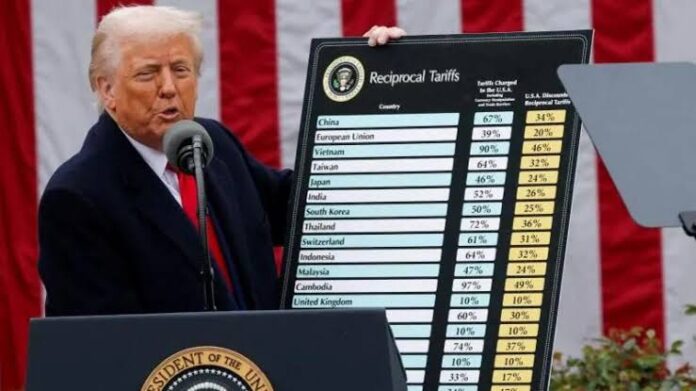
Donald Trump has imposed a 50% reciprocal tariff on Lesotho, a small, landlocked country in southern Africa. The announcement, made earlier this week, marks the highest tariff currently imposed by the Trump administration and signals a deeper shift in America’s trade posture under Trump’s renewed leadership.
Lesotho, despite its size and a modest GDP of just over $2 billion, has long maintained a strong trade relationship with the United States. Much of that relationship is rooted in the export of diamonds and textiles—including the very Levi’s jeans worn by millions of Americans.
According to Oxford Economics, Lesotho exported $237 million worth of goods to the U.S. in 2024—accounting for more than 10% of the country’s GDP. But that trade flow now faces a steep roadblock, as Trump’s tariffs take aim at what he sees as an imbalanced playing field.
“These countries have taken advantage of us for too long,” Trump said during a press briefing. “If they want access to our market, they’ll have to treat us fairly.”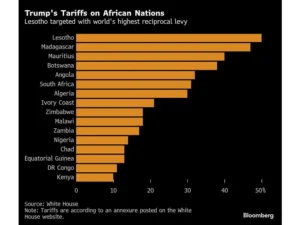
Ironically, just a year ago, Trump publicly brushed off Lesotho as a place “nobody has ever heard of.” Now, the nation finds itself at the center of one of the administration’s most aggressive trade actions to date.
The justification? Lesotho’s 99% tariff on U.S. goods. Under Trump’s tariff formula—tied to America’s trade deficit with each nation—the 50% rate was deemed “fair and reciprocal.” Still, trade experts warn this tit-for-tat approach could be devastating for African economies, especially those that depend heavily on exports to the U.S.
“This is a clear reversal of decades of U.S. trade policy toward Africa,” said one Washington-based analyst. “It threatens to undo years of progress made under agreements like AGOA.”
Also, read: 15-Year-Old Autistic Nigerian Sets Guinness World Record with Largest Canvas Painting
The African Growth and Opportunity Act (AGOA), which had provided duty-free access to U.S. markets for many African nations, including Lesotho, now appears all but defunct under Trump’s second term. His administration’s pivot away from multilateral development initiatives has already seen major funding cuts to USAID, impacting key sectors like healthcare and education in countries across the continent.
Lesotho’s government has not issued an official response yet, but its foreign minister had previously warned that reduced American aid was already straining the country’s health system—one that battles among the highest HIV/AIDS rates in the world.
For ordinary Basotho citizens, this tariff isn’t just a trade headline—it could mean job losses, factory closures, and rising uncertainty in an already fragile economy.
Beyond Lesotho, the ripple effects are being felt across southern Africa. Citrus growers in South Africa, for instance, worry that Trump’s wider tariff regime—including a 30% levy on South African imports—could disrupt the seasonal balance they help provide to American consumers.
“We don’t compete with U.S. citrus,” said Boitshoko Ntshabele, head of the Citrus Growers Association in Johannesburg. “We support it during off-season gaps. Everyone loses if this escalates.”
President Cyril Ramaphosa of South Africa echoed the concern, calling for immediate bilateral trade talks to prevent further damage to African economies.
As Trump doubles down on his “America First” trade approach, many are left wondering what role, if any, African nations will play in the U.S. economic landscape going forward. For Lesotho, the answer may come at a high cost.

