
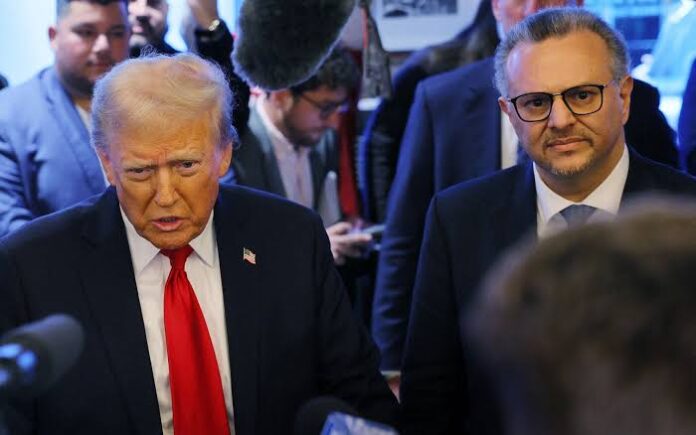
Amid growing criticism over sweeping foreign aid cuts that have rattled humanitarian programs across Africa, President Donald Trump’s administration is pushing back on claims that the continent has fallen off Washington’s radar.
In a recent sit-down with the BBC, U.S. Senior Advisor for Africa, Massad Boulos, made it clear: “Africa is very important to President Trump.” That message comes at a time when many African nations are grappling with the consequences of the administration’s budget-slashing foreign policy.
Since resuming office, Trump has revived his “America First” agenda, a doctrine that favors domestic priorities over international spending. Within days, his administration halted key aid flows to multiple African nations. These cuts have disrupted critical health services, including the delivery of HIV medications and supplies for disease control.
Yet Boulos insists that the administration’s intention isn’t abandonment, but accountability. “We’re not pulling away from Africa. We’re simply taking a long, hard look at where the money is going—and whether it’s really doing what it’s supposed to do,” he told BBC Newsday.
But the impact has been felt. Clinics across South Sudan have shut their doors. Health workers have gone unpaid. Just this month, Save the Children confirmed the deaths of eight people—including five children—who had walked miles in search of cholera treatment, only to find help out of reach. While Boulos says these deaths can’t be directly linked to Washington’s funding freeze, many international aid groups disagree.
The World Health Organization has already flagged an alarming possibility: if support doesn’t resume soon, up to six African countries—including Nigeria and Kenya—could run out of HIV treatments entirely. Meanwhile, the Institute for Security Studies warns that nearly six million more Africans could fall into extreme poverty by next year as a direct result of the aid withdrawal.
Still, Boulos maintains that oversight is essential. “The U.S. has a responsibility to make sure that our foreign aid is effective, not just generous,” he said.
The advisor—whose son is married to Trump’s daughter Tiffany—recently wrapped up a multi-country tour through East and Central Africa, including stops in Kenya, Uganda, Rwanda, and the Democratic Republic of Congo. One of the trip’s key objectives: exploring trade and investment opportunities for American companies, particularly in Africa’s booming mineral sector.
Also, read: Wunmi Mosaku Reconnects with Her Yoruba Roots in Ryan Coogler’s ‘Sinners’
Boulos revealed that several U.S. firms have expressed interest in the DRC’s rich reserves of lithium, a mineral critical to powering electric vehicles and electronics. With China currently dominating the market, Congo’s President Félix Tshisekedi sees a window for American engagement—both to rebalance economic interests and potentially stabilize the conflict-ridden eastern region, where Rwandan-backed M23 rebels have seized territory.
Boulos was clear: “We’re ready to explore mineral partnerships, but Rwanda must first withdraw its troops and stop fueling instability in the DRC.” Kigali continues to deny involvement in the conflict.
When asked whether America’s return to Africa is purely transactional—more about business than people—Boulos didn’t shy away. “Our job is to promote U.S. interests and build real strategic partnerships. But that doesn’t mean we don’t care. Peace, security, and prosperity are in everyone’s interest.”
He pointed to the ongoing crisis in Sudan as an example of where President Trump wants the U.S. to play a constructive role. “He’s committed to ending wars, not starting them,” Boulos said.
On the trade front, Trump’s recent tariffs on African exports have stirred uncertainty. Lesotho, for example, was hit with a 50% tariff on its textile exports to the U.S.—a devastating blow to an economy heavily reliant on the African Growth and Opportunity Act (AGOA). The tariff has been temporarily suspended, but there are fears it may return. AGOA itself is at risk, with many analysts predicting the current Republican-led Congress may not renew the program.
Boulos downplayed the impact, arguing that the tariffs affect “very small trade volumes” and that negotiations are underway. “At the end of the day, what we want is fairness—for African producers and for American businesses.”
Despite rumors that the U.S. is preparing to shut down several diplomatic missions in Africa, Boulos was dismissive. “That’s simply not true. Africa is not being sidelined. It’s being re-engaged—just on new terms.”

