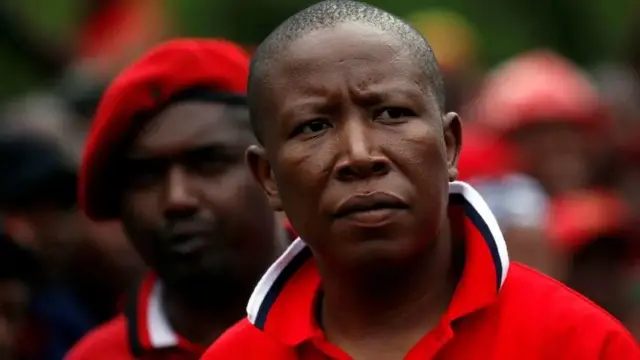
South African opposition leader Julius Malema, a polarizing figure in both domestic and international politics, has once again been denied entry into the United Kingdom, this time on grounds far weightier than paperwork.
In a letter made public by his Economic Freedom Fighters (EFF) party, the UK Home Office stated that Malema’s presence in Britain was deemed “non-conducive to the public good,” pointing to inflammatory remarks the politician has made in recent years. The decision, officials said, is based on both his controversial statements on race relations in South Africa and his vocal support for Hamas.
Malema, a longtime critic of Western imperialism and capitalism, has repeatedly drawn attention—and condemnation—for his confrontational rhetoric. The UK cited a 2023 speech where he claimed that the EFF would “arm Hamas” if it came to power, as well as previous comments that were seen as encouraging violence against white South Africans.
This marks the second time in two months that the UK has barred Malema from entering its borders. The first was written off as a late application. This time, however, British officials say it was a deliberate, substantive ban, with no right of appeal and the likelihood of future denials.
For his part, Malema has not softened his stance. His party responded sharply, calling the decision “cowardly” and accusing the UK of twisting Malema’s words and failing to understand the political realities of post-apartheid South Africa.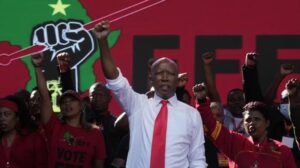
“We will not trade our revolutionary beliefs for visas,” the EFF said in a statement, doubling down on Malema’s commitment to support oppressed people worldwide, especially Palestinians.
Also, read: Nigeria Seeks Diplomatic Rapprochement with Mali, Niger, and Burkina Faso Despite ECOWAS Rift
The party also emphasized that Malema’s rhetoric—however controversial—is a response to what they describe as systemic economic exclusion of Black South Africans, and that frustration over persistent racial inequality should not be confused with calls to violence.
Malema is no stranger to headlines. A former leader of the African National Congress Youth League, he launched the EFF in 2013, campaigning for radical land redistribution, nationalisation of key industries, and a hardline stance against Western interests in Africa.
He’s also been at the center of countless public debates over hate speech. One flashpoint was his participation in protest songs like “Kill the Boer”—a reference to white farmers—which recently resurfaced in a video shared by U.S. President Donald Trump during a diplomatic visit from South Africa’s President Cyril Ramaphosa.
Trump used the video to suggest Malema incites violence against South Africa’s white minority. However, South Africa’s Supreme Court of Appeal ruled last year that the lyrics, though provocative, do not legally constitute hate speech, and should be understood in the context of political performance and historical protest traditions.
To his supporters, Malema is a truth-teller—an unfiltered voice for South Africa’s dispossessed youth, speaking boldly where others play it safe. They argue that the UK’s decision reflects Western discomfort with African radical thought, and suppresses legitimate critiques of global inequality.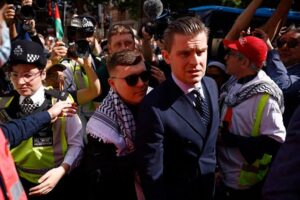
But to his critics, both in and outside South Africa, Malema’s rhetoric teeters too dangerously on the edge of extremism. They see the UK’s move as a necessary response to someone whose words carry weight—and potential consequences.
The Broader Picture: South Africa’s Struggles Continue
Beyond the diplomatic standoff, Malema’s rise and ongoing controversy reflect deeper fractures in South African society. Unemployment is at 33%, and Black South Africans remain disproportionately affected by poverty and joblessness. For many young voters, the slow pace of reform has made Malema’s radical messaging appealing, even if it comes at a global cost.
However, the EFF’s grip on the national stage appears to be loosening. In last year’s elections, the party slipped from third to fourth, ceding ground to former president Jacob Zuma’s new party, uMkhonto weSizwe (MK).

