
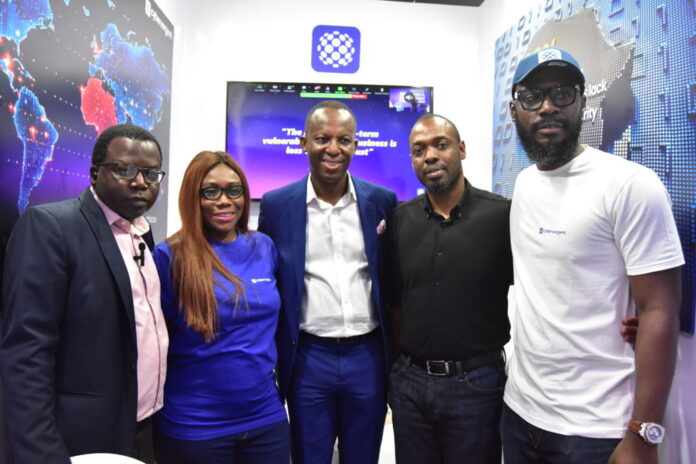
There is a particular kind of satisfaction that comes when a Lagos-built product walks into the most regulated tech market on the African continent and lands a customer before the press release is even cold. That is exactly what happened last week, and the Nigerian AI startup behind it — Cybervergent — has a story that most people outside the tech industry haven’t heard yet. They probably should.
In a single week, Cybervergent, Africa’s first AI-native posture management platform, launched an improved third version of its product and expanded into Kenya, Ghana, and South Africa simultaneously. For a company that spent over a decade building without a single rand, shilling, or dollar of external investment, it is the kind of move that rewrites the story of what African tech can produce.
What Is Cybervergent? The Nigerian AI Startup Challenging a $3.67 Billion Market

Before unpacking what this expansion means, it helps to understand what this Nigerian AI startup actually does — because “cybersecurity” does not quite cover it.
Cybervergent operates in the governance, risk, and compliance (GRC) space — a sector currently dominated globally by giants like SAP, IBM OpenPages, ServiceNow GRC, Oracle Risk Management, and RSA Archer. These are billion-dollar platforms used by multinational corporations to manage regulatory compliance, audit processes, data security, and operational risk. The Lagos-based company unifies compliance, risk, audit, and data security into a single, continuously updated posture, delivering real-time visibility, defensible assurance, and confidence across cloud and on-premise environments.
The critical difference between Cybervergent and those global incumbents is not just the price point or the African focus. It is the architecture itself. Most legacy GRC tools — including the biggest names in the industry — still rely on periodic, point-in-time reporting: a compliance audit happens once or twice a year, the results are logged, and the organisation hopes nothing changes between reports. Instead of relying on periodic audits, Cybervergent continuously monitors systems, allowing organisations to demonstrate compliance and security readiness at any time.
That distinction matters enormously in a continent where Africa has already suffered more than $3 billion in total cyber incident losses between 2019 and 2025, and where cyberattacks cost some African economies up to 10% of GDP every year.
Also read: Groundbreaking African Inventions in Technology
The 14-Year Bootstrap: How This African Cybersecurity Startup Built Without Outside Money

The backstory of this African cybersecurity startup is perhaps the most remarkable part of the story — and the part that tends to silence rooms.
Cybervergent was founded by Adetokunbo Omotosho in 2012, tracing its roots to a cybersecurity consulting firm built to help Nigerian banks secure their systems. Omotosho previously helped build cybersecurity infrastructure at Interswitch, including work on Payment Card Industry Data Security Standard compliance, an experience that exposed him to the scale of security vulnerabilities in Africa’s growing digital ecosystem.
For over a decade, the company took no external investment. No venture capital. No seed rounds. No angel cheques. Just revenue, customers, and relentless product development. Omotosho considered raising capital a distraction, noting that the most important thing was building a solid foundation before thinking of scaling rapidly.
By the time the company took its first external cheque in early 2026, it had already built something that did not need rescuing. The platform serves more than 150 enterprise clients across West, East, and Southern Africa — in heavily regulated industries including banking, insurance, telecoms, and fintech — and covers more than 100 regulatory frameworks across the Pan-EMEA region, mapping over 4,500 regulatory controls.
The $3 million seed round, co-led by Ventures Platform, marking the first investment from its Pan-African Fund II, and Atlantica Ventures, was not a lifeline. It was fuel for a machine that had already proven itself.
What Makes This Nigerian Tech Startup Expansion Different From the Rest

Three-market expansions are announced regularly in the African tech space. What makes this Nigerian tech startup expansion worth paying close attention to is the specific nature of the markets chosen — and what succeeding in them actually proves.
Kenya and Ghana represent well-travelled corridors for Nigerian companies moving into East and West African markets. They are familiar with the regulatory terrain. But South Africa is a different proposition entirely.
South Africa’s compliance environment is more demanding, its enterprise buyers more scrutinising, and its existing pool of global GRC vendors more entrenched. Cybervergent positioned the South Africa entry not just as a market win but as a benchmark — the clearest signal yet that an African-built compliance platform can compete where global standards are most stringent.
They did not just enter South Africa. The company confirmed its first local customer, operating in the technology and AI sector, though the name is being withheld at the customer’s request. A paying enterprise customer in Africa’s most demanding regulatory environment was secured before the announcement was even published.
To understand how significant that is, consider the competition they displaced to get there: ServiceNow GRC, SAP’s compliance suite, IBM OpenPages, RSA Archer — platforms backed by companies with combined market capitalisations in the hundreds of billions of dollars, with sales teams, local offices, and years of entrenched relationships on the ground in Johannesburg and Cape Town. A Lagos tech startup just walked onto that playing field and scored.
The AI Compliance Platform Africa Has Been Waiting For: Version 3.0 Explained

The timing of this three-market expansion was not accidental. It coincided with the launch of Cybervergent’s Version 3.0 — a significant platform upgrade that sharpens what was already the sharpest edge of this AI compliance platform Africa story.
Version 3.0 introduces continuous posture management across four domains: risk, compliance, audit, and data security, mapping over 4,500 controls across major regulatory frameworks, including Nigeria’s Data Protection Act, GDPR, ISO 27001, and SOC 2.
The headline technical claim of v3.0 is the one that has been generating the most discussion in enterprise circles: its v3.0 system verifies up to 99.9% of audit findings and provides real-time oversight across risk, compliance, audit, and data security. The industry average for automated verification sits between 0% and 10%. The gap between those two numbers is not a marginal improvement — it is a category difference.
For African enterprises operating across multiple jurisdictions — a Nigerian bank with operations in Ghana, Kenya, and the UK, for example — this means a single assessment can satisfy compliance requirements across all of those regulatory environments simultaneously, rather than running four separate audit cycles with four different tools.
The platform also reduces manual compliance workload by over 70%, according to the company’s customer deployment data — a figure that addresses one of the most persistent bottlenecks in African enterprise operations: the shortage of qualified compliance professionals relative to the complexity of regulatory environments they must navigate.
Why the African Cybersecurity Market Is the Battlefield That Matters Right Now

The timing of this African cybersecurity startup’s expansion aligns with one of the most important structural shifts in African enterprise technology.
Africa’s cybersecurity market is expected to grow from USD 0.68 billion in 2025 to USD 0.77 billion in 2026, and is forecast to reach USD 1.44 billion by 2031 at a 13.3% compound annual growth rate. That growth is being accelerated by a wave of new data protection legislation across the continent: Nigeria’s Data Protection Act, South Africa’s POPIA, Kenya’s Data Protection Act — laws that are now carrying real teeth. Nigeria’s 2023 Data Protection Act prompted 92% of surveyed organisations to strengthen security controls within 12 months, while Meta’s USD 220 million fine illustrated regulators’ willingness to impose material penalties for non-compliance.
For African enterprises, this is no longer an abstract risk. Compliance failure now carries financial consequences that land on balance sheets. And the global tools that have traditionally been sold into these markets — built for Western regulatory environments, priced for Western enterprise budgets, and requiring Western-style infrastructure to operate — are not optimised for the hybrid cloud and on-premise realities that most African organisations actually run.
That is the structural gap that Cybervergent was built to fill. Not as an African approximation of a global product. As an African-native platform that is, by design, better suited to this environment than the incumbents.
Also read: Five Amazing Tech Innovations For Africans
World Economic Forum Recognition: When Global Validation Meets African Innovation

One detail that tends to be underreported in coverage of this Nigerian AI startup is the level of global institutional recognition the company had already secured before making this expansion move.
In 2025, Cybervergent was named a Technology Pioneer by the World Economic Forum — a designation awarded annually to approximately 100 startups globally that are identified as using AI and emerging technologies to drive transformational change in their industries. Previous WEF Technology Pioneer cohorts have included companies that went on to become household names in their sectors.
Being named a WEF Technology Pioneer does not just provide prestige. It provides a credibility layer that matters specifically in enterprise sales — the kind of independent third-party validation that shortens procurement cycles in regulated industries where decision-makers are accountable to boards, regulators, and shareholders. When a Nigerian AI startup is competing against SAP and IBM for an enterprise contract in Johannesburg, that credibility layer is not decorative. It is functional.
What Cybervergent’s Rise Means for African Tech Startups and the Continent’s Digital Future
The expansion of this Nigerian AI startup into three simultaneous markets carries significance that extends well beyond one company’s growth trajectory.
For years, the dominant narrative around African enterprise technology has been one of adaptation: global tools being localised, Western platforms being brought to African markets, and multinational companies building for Africa as an afterthought. Cybervergent inverts that narrative completely. For years, the global tech narrative viewed Africa as a regulatory afterthought — a place where governance, risk, and compliance were historically treated as a mere bolt-on documentation exercise rather than a front-line defence. Today, Cybervergent is dismantling that notion by replacing static reporting with automated, continuous risk management.
The company was not built to approximate what existed elsewhere. It was built because what existed elsewhere was not built for here. That is a fundamentally different origin story — and it produces a fundamentally different product.
The market it is entering is enormous. The African cybersecurity market is projected to reach USD 25.79 billion by 2033, growing at a CAGR of 20.43% from 2024. The players currently occupying that market are global giants with little institutional knowledge of African regulatory complexity, African infrastructure realities, or African enterprise workflows.
A Lagos tech startup that spent 14 years quietly building the expertise those giants lack, in the market those giants underinvested in, has just announced it is coming for that market — with a product that outperforms the industry standard, a WEF endorsement, institutional backing, and paying customers in the most demanding regulatory environment on the continent.
It happened in one week. The next chapter should be considerably more interesting.

